

Shock absorbers
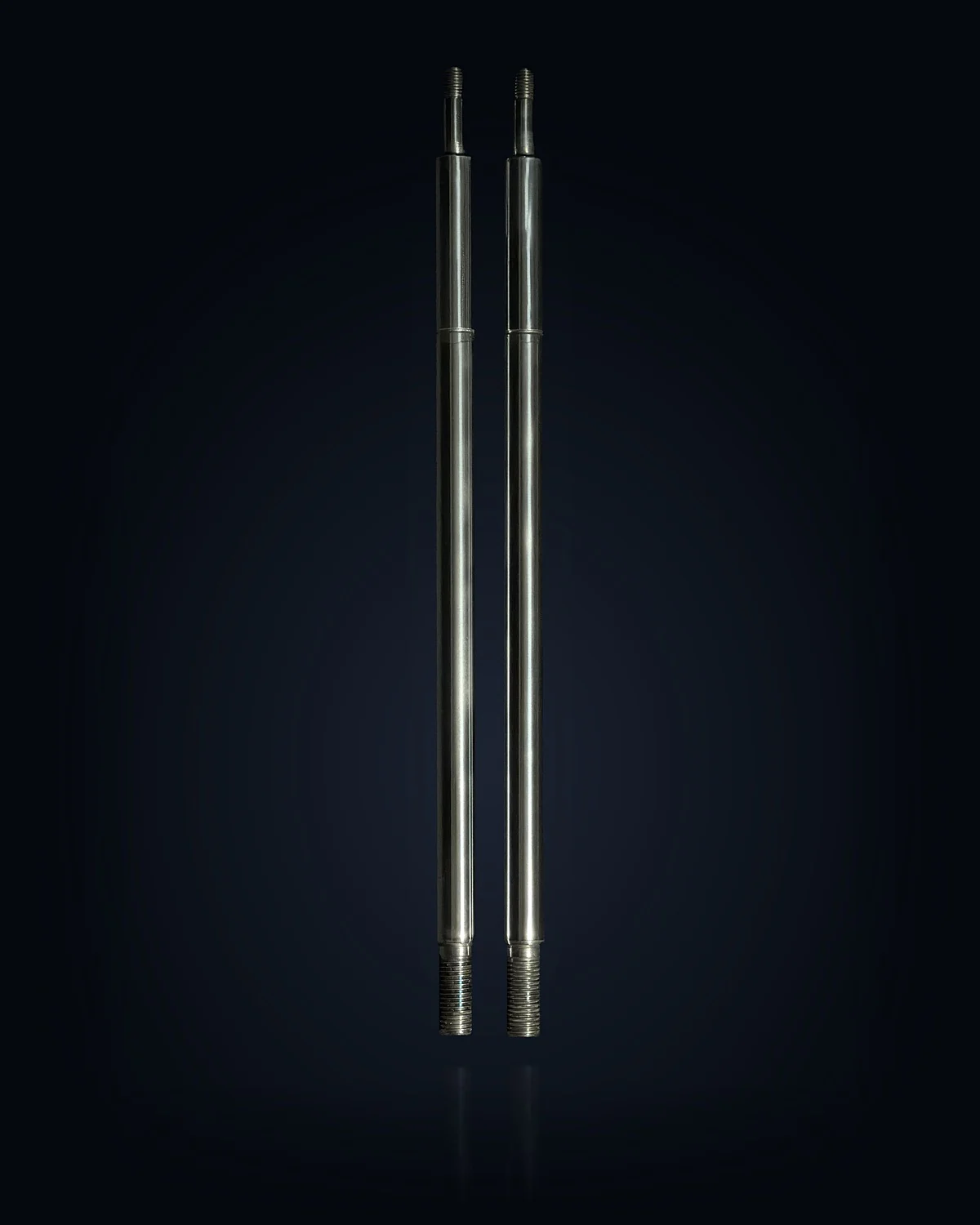
TripleHard® on shock absorber rods
For shock absorber rods, an existing Cr(VI) line can be converted to TripleHard®. A shock absorber rod coating cell has been designed by Savroc.
Less sliding wear than Cr(VI) hard chrome at the same thickness, and lower seal leakage than the Cr(VI) reference in a 250,000-cycle test by a global OEM. Made in a Cr(III) hard-chrome process.
- 4×
- less sliding wear than hard chrome on the same shaft at 15 µm
- 250k
- cycles in a global OEM's seal test: lower leakage than the Cr(VI) reference
- 1,275 lbf
- block-on-ring load without galling; hard chrome galled at 1,125 lbf
Why shock absorbers
The rod that never stops moving.
A damper rod strokes through its seal continuously, under side load, in road grit and salt. Friction, wear and seal life decide how long the damper feels new.
- Galling resistance. Carried the full block-on-ring load where hard chrome failed
- Wear. Half the Taber wear of hard chrome; a quarter in sliding wear
- The seal. Lower seal leakage than the Cr(VI) reference in a 250,000-cycle test by a global OEM
- Corrosion. Rating 10 at 1000 h in neutral salt spray, depending on the nickel underlayer
How it is produced
On a converted line.
Current Tested; Savroc has designed a shock absorber rod coating cell. Coated in open tanks or such a cell, not on the continuous line. Volume production is possible there but has not started. Results here are coating tests on specimens and parts.
Shock absorber rods are plated on your existing line, converted: a TripleHard® Cr(III) bath replaces the Cr(VI) bath and a nickel bath is added where the line has none. Savroc supplies the process and the support, and simulates and engineers each conversion for your parts.
Read the technology page How a project works- Changes in a conversion
- Carries over from the existing line
- Carries overHoist and railThe existing hoist carries the part from tank to tank.
- Carries over1 · Surface preparationCleaning, as on the existing line.
- Carries over2 · EtchingActivates the steel surface, as on the existing line.
- Changes3 · Nickel anchor layerA nickel bath is added where the line has none.
- Changes4 · TripleHard® Cr(III) bathReplaces the Cr(VI) bath with a TripleHard® Cr(III) bath.
- Carries overRinses and handlingThe rinse after each stage and the existing handling stay as they are.
Technical package
What is measured.
Full test conditions and the regulatory position are on the technology page.
| Galling (block-on-ring) | Step loading over 3,200 s: no galling up to the maximum 1,275 lbf (about 850 MPa); the Cr(VI) reference galled at 1,125 lbf |
|---|---|
| Abrasion (Taber) | CS-10, 1,000 cycles, 1 kg: 1.03 mg against 2.0 mg |
| Sliding wear | A quarter of the wear depth of hard chrome on the same shaft at 15 µm (case study) |
| Seal leakage | In a 250,000-cycle test performed by a global OEM, TripleHard® showed lower seal leakage than the Cr(VI) reference |
| Corrosion | NSS (ISO 9227): rating 10 at 1000 h, and at 250 and 500 h; depends on the nickel underlayer |
Frequently asked questions
How was the block-on-ring test run?
A coated ring ran against a carburised steel block, grease-lubricated at room temperature and constant speed, with the load stepped from 50 to 1,275 lbf. A Cr(VI) hard chrome ring ran under the same conditions as the reference. The full report is available on request.
Does TripleHard® change the damping?
Damping is verified in the customer's own damper during commissioning; in a 250,000-cycle OEM test the seal leaked less than with the Cr(VI) reference.
Can I run it on my existing line?
Yes. The route for shock absorber rods is a converted line or a coating cell designed by Savroc; most infrastructure carries over. The continuous line is for hydraulic cylinder rods.
Contact
Ready to start your move off hexavalent chromium?
Talk to us about your parts and the targets they must meet. A first conversation needs no drawings.